eV CHARGERS
Everything you ever wanted to know about eV charging – A Comprehensive Guide
what is a Charging Station?
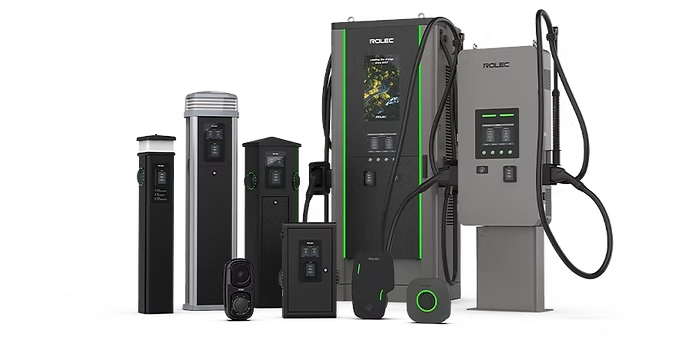
A charging station — often called a charge point, chargepoint, or electric vehicle supply equipment (EVSE) — is a device that delivers electrical energy to recharge plug-in electric vehicles. This includes battery electric cars, plug-in hybrids, as well as larger electric vehicles such as trucks, buses, and neighbourhood EVs.
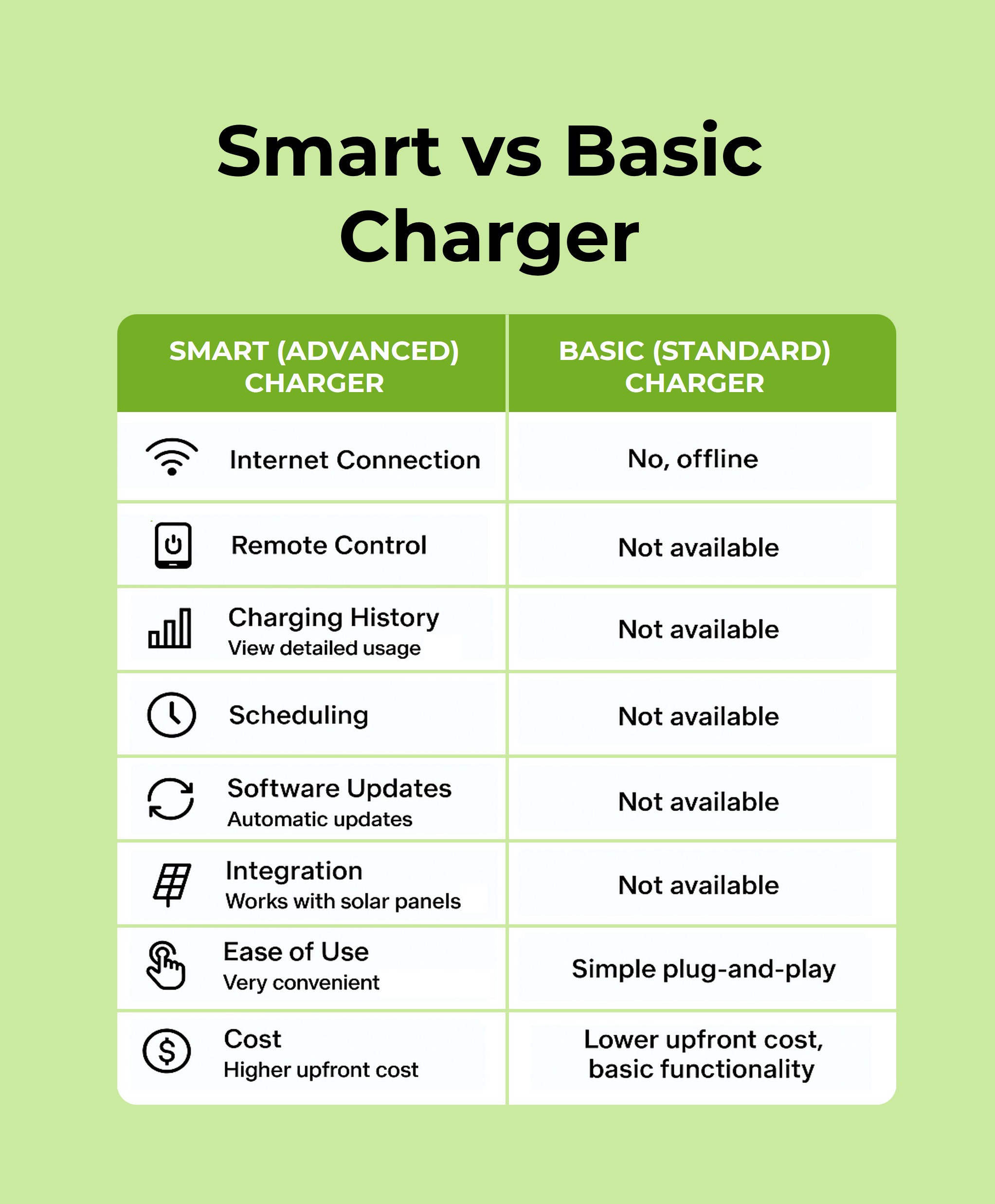
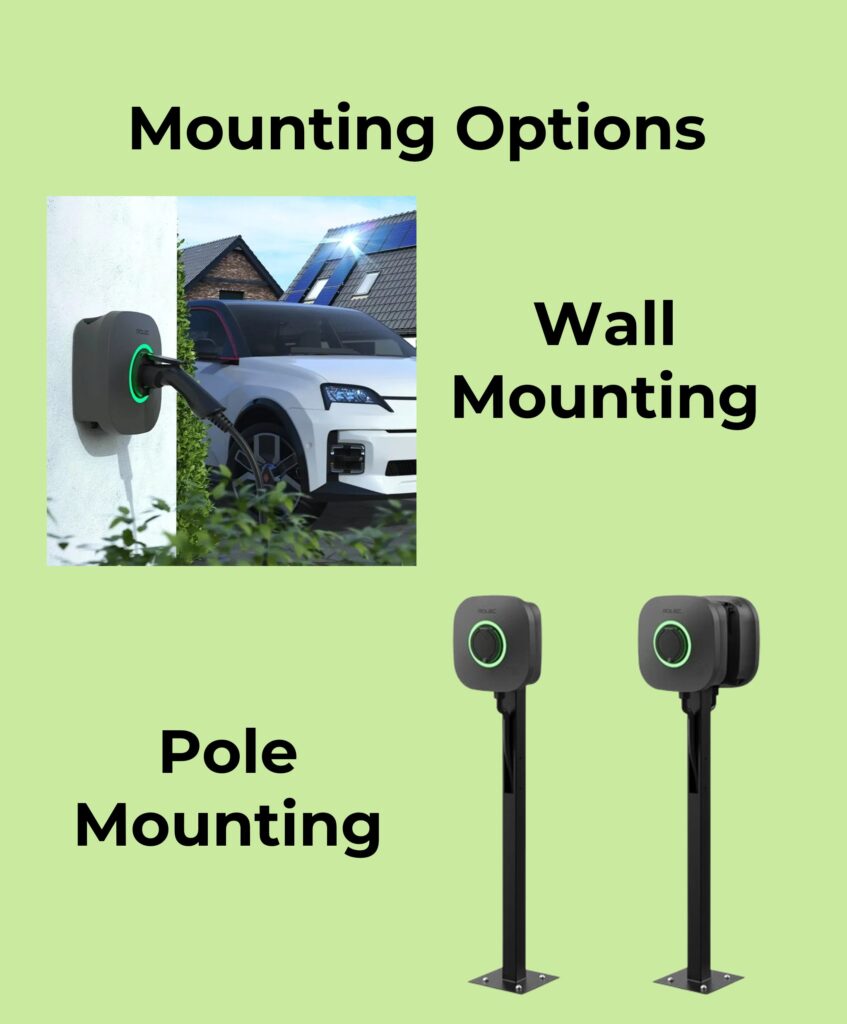
In the Netherlands, EV chargers come in basic (non-smart) and smart versions. Basic chargers provide straightforward, reliable charging without connectivity or dynamic features, while smart chargers allow remote monitoring, app integration, and cost optimization through dynamic pricing. Both types can be installed on a wall or on a pole: wall-mounted chargers are compact and ideal for garages or driveways, offering a neat and secure installation, whereas pole-mounted chargers are freestanding, flexible for open spaces, and convenient for multiple parking spots. The choice depends on space, accessibility, and whether you want advanced smart features.
Charging Methods
EVs can be charged using AC (alternating current) or DC (direct current) methods. AC charging, common at home or public stations, converts grid electricity to the car’s battery voltage via the onboard charger and is typically slower, ideal for overnight or long-duration charging. DC fast charging bypasses the onboard charger, delivering high-voltage power directly to the battery for rapid top-ups, usually found at highway stations for quick long-distance travel. The choice depends on convenience, charging speed, and battery capacity.
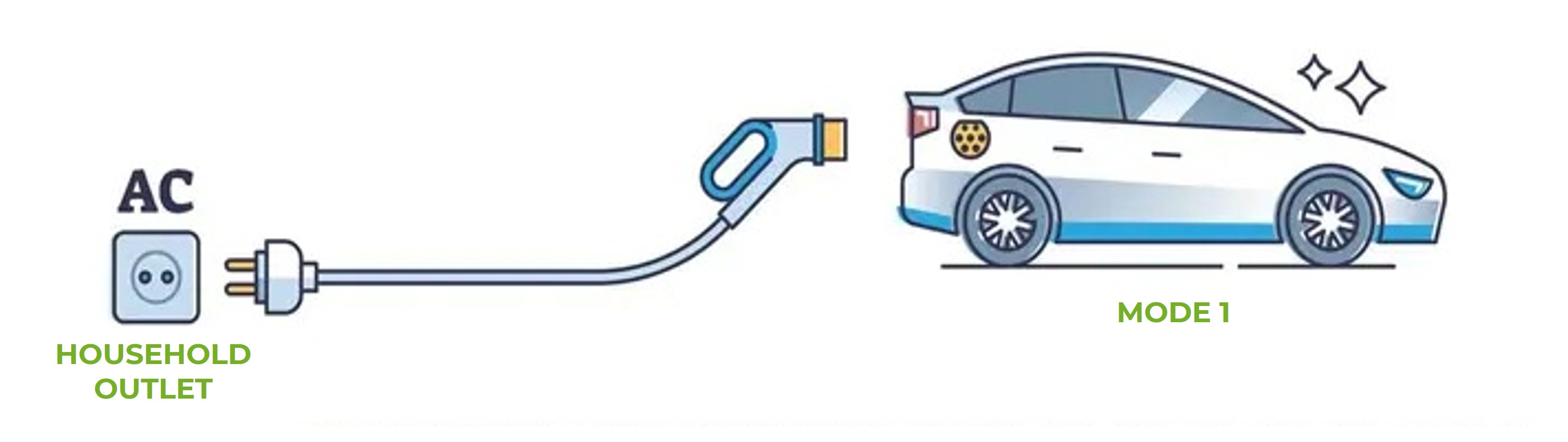
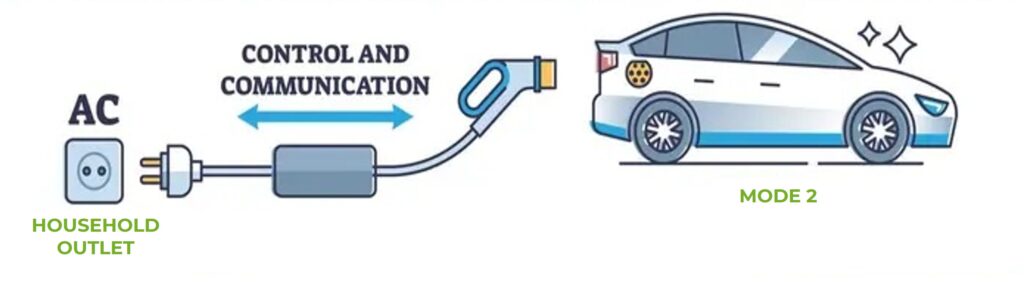
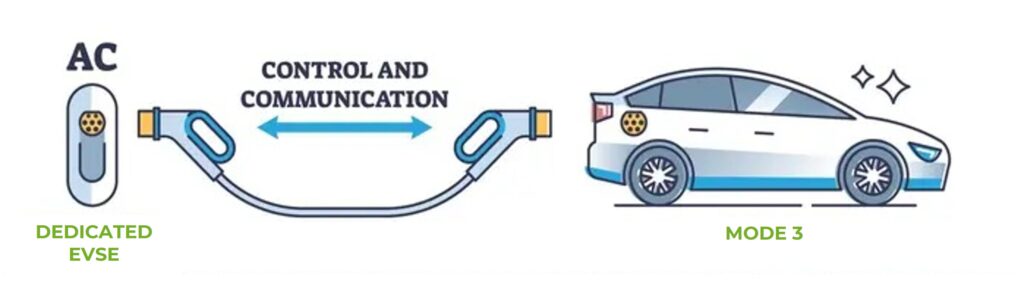
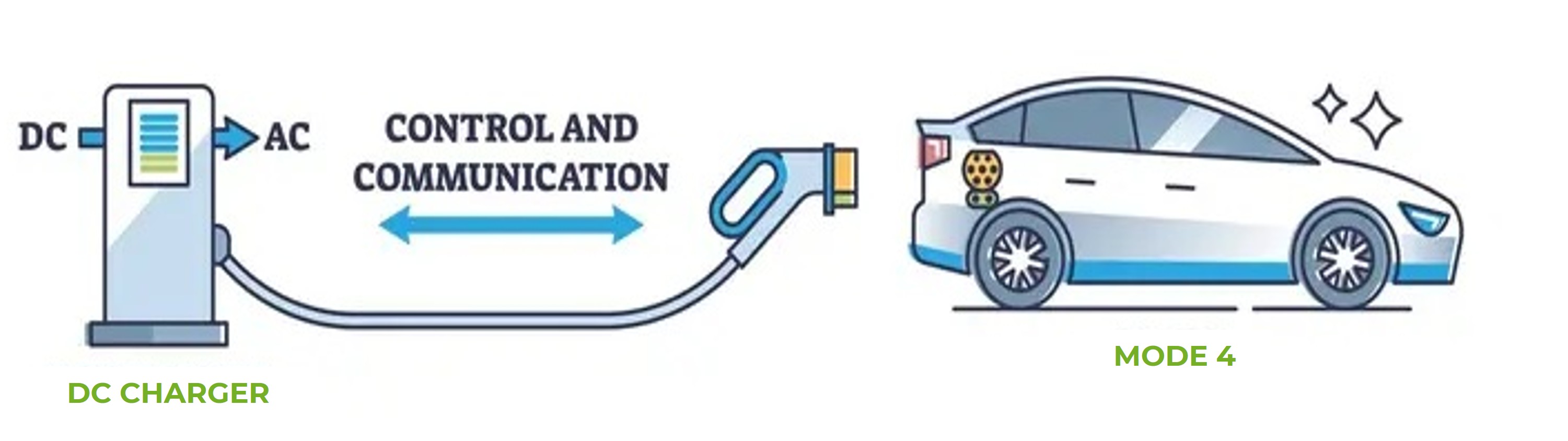
EV charging is classified into four modes, which define how the vehicle connects to the power source and the level of safety control:
what is aC and DC Current?
In electric vehicle charging, the higher the charging level, the faster your car charges. But what exactly are AC and DC, and why is DC faster?
AC vs DC Current
AC stands for Alternating Current, which periodically changes direction. DC stands for Direct Current, which flows in a single, steady direction. AC is ideal for transporting electricity over long distances, which is why the power coming from your home or office socket is AC. On the other hand, batteries store energy as DC, and most electronic devices operate on DC.
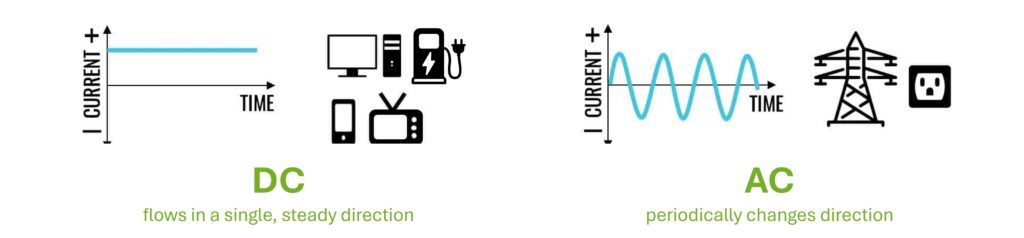
Whenever you charge your phone or any device, the charger converts the AC power from the grid into DC power to fill the battery.
How Do Electric Cars Charge?
The same principle applies to electric vehicles (EVs). The difference between AC and DC charging comes down to whether a conversion is needed before reaching the battery. Ultimately, EV batteries always store DC electricity.
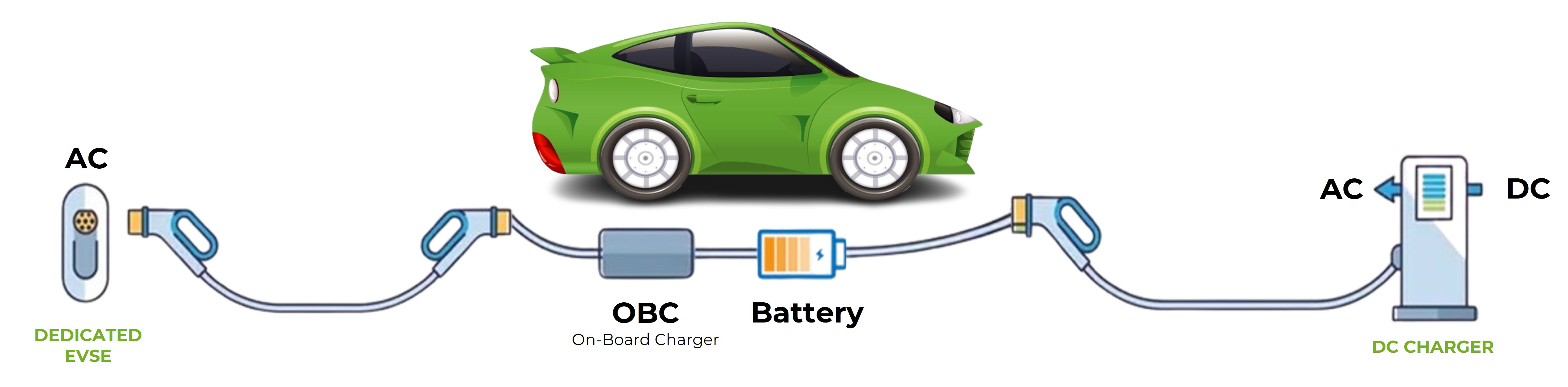
- DC Charging: The charger itself converts AC from the grid into DC and supplies it directly to the battery.
- AC Charging: The vehicle must use its built-in converter (the onboard charger) to turn AC into DC before the battery can charge. Since onboard chargers are smaller and have limited capacity, AC charging is usually slower than DC charging.
Types of EV Chargers
There are two main types of chargers: AC chargers and DC chargers. EV batteries can only charge with DC power, but most electricity from the grid is AC. To handle this, EVs come with an onboard AC-to-DC converter.
- AC Chargers: Supply AC to the car’s onboard converter, which then turns it into DC for the battery.
- DC Chargers: Have a built-in AC-to-DC converter in the station itself, bypassing the car’s onboard system. This allows higher power delivery and faster charging, since the station’s converter can be much larger than the car’s.
Most modern EVs can handle both AC and DC charging. Public AC charging stations often provide three-phase current, such as 400V at 16A (11 kW), 400V at 32A (22 kW), or 400V at 64A (44 kW). Vehicles with larger inverters can take advantage of higher currents to charge faster.
AC vs DC Charging
connectors (Plugs)
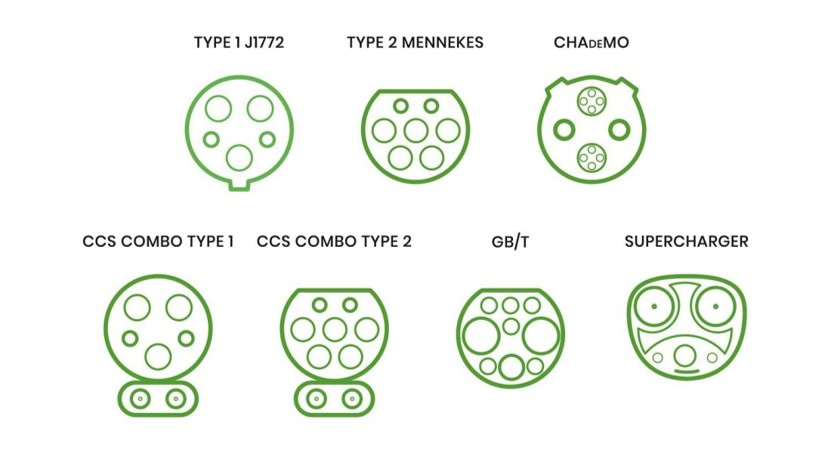
Key Connector Types
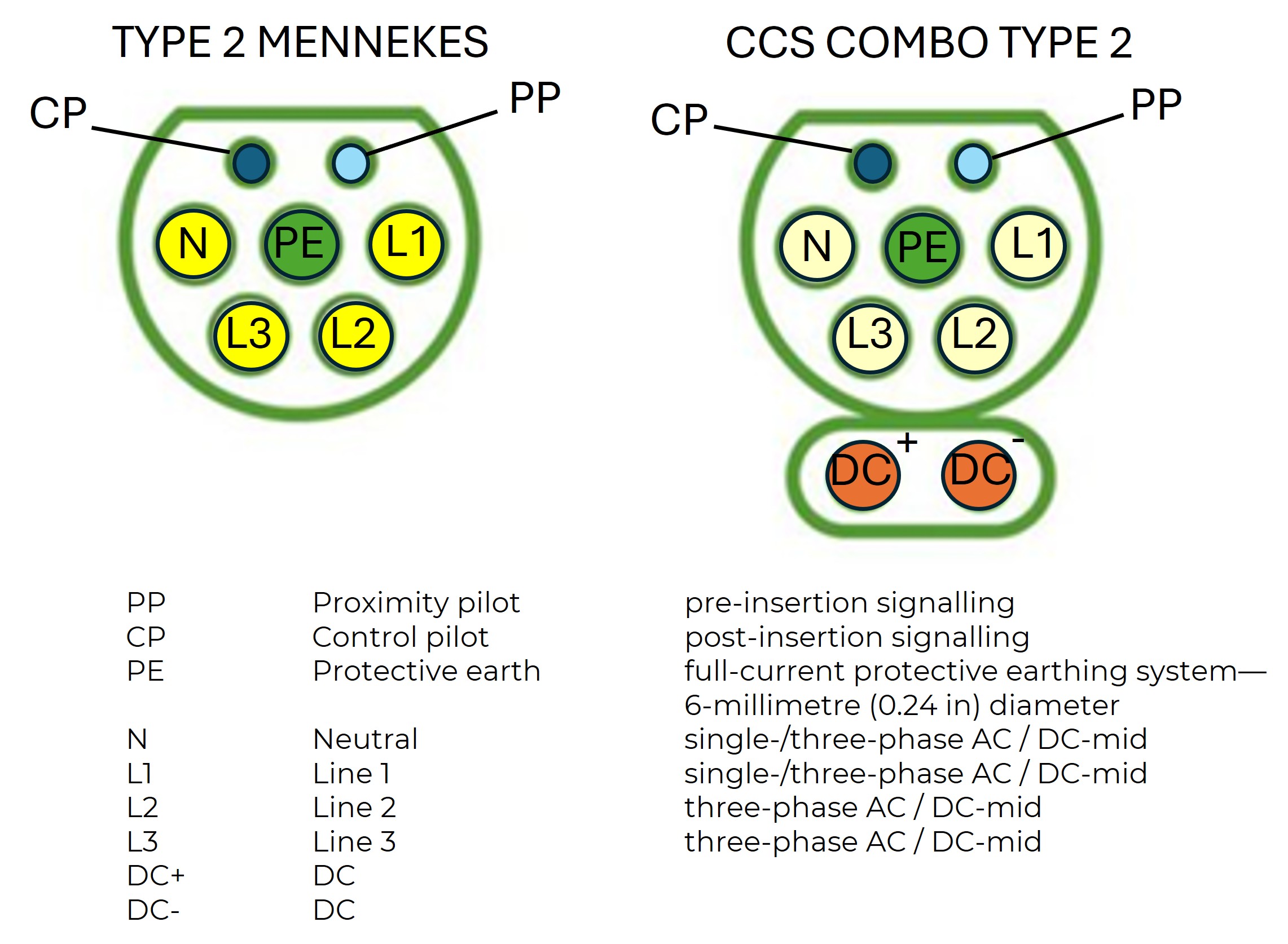
Pinout for Type 2 Plug:
Regulation, Standards & Legal Requirements
- Type 2 required by law
Under the EU’s Alternative Fuels Infrastructure Regulation (AFIR) and national legislation, public AC charging points in the Netherlands (and broadly in the EU) must use Type 2 connectors. - NEN 1010
Electrical installations (including charging points) must comply with NEN 1010 (Dutch standard for low-voltage electrical installations) to ensure safety. - Measurement & Metering
For home chargers used for business cars, or in situations where accurate electricity billing is needed, meters may need to comply with MID (Measuring Instruments Directive) certification. Tesla has released a Wall Connector in NL with a MID-certified meter. - Standards for Smart & Bidirectional Charging
New technical guidelines are defining minimal requirements for smart charging and bidirectional (vehicle-to-grid, V2G) infrastructure. These include protocols, communications, and compliance to ensure future-proofing.
Practical Implications & Trends
MID-certification is becoming more relevant, especially for business use, for billing accuracy. Installing a MID-certified wallbox may help if you need to reimburse employees, or if precise metering is legally or contractually important.
Because Type 2 + CCS2 are the mandated / dominant standards, most new EVs and charging stations in the Netherlands are designed around these. If you get a car or charger, ensure it supports CCS2 for fast DC charging and Type 2 for AC.
Adapters may be useful for older cars with CHAdeMO or other non-CCS fast-charge standards, but availability is decreasing.
Tesla Supercharger accessibility: As of mid-2024, Tesla has opened up many of its Supercharger stations in NL to non-Tesla vehicles via CCS2.
From Plug to Power: Everything You Need to Know.
Electric Car charging times
To help you understand charging times, we’ve put together a simple overview below. It shows how long it usually takes to charge three common EV battery sizes at different charging speeds.
Assumptions for this table:
- “Small EV” = ~40 kWh battery (e.g., Nissan Leaf 40).
- “Medium EV” = ~60 kWh battery (e.g., VW ID.3).
- “Large EV” = ~90 kWh battery (e.g., Tesla Model S / Mercedes EQS).
- For illustrative purposes only: Times are approximate and depend on the car’s max charging capability and state of charge. For illustrative purposes only:
- For fast and ultra-fast charging, only the 10–80% window is shown (since charging slows down after 80%).
Why EVs Usually Charge Up to 80% at Fast Chargers
When you plug into a DC fast charger (50 kW, 150 kW, 350 kW, etc.), your EV charges very quickly — but only up to a point. Most EVs are designed to charge at full power until around 80%, after which the charging speed slows down dramatically.
Why?
- Battery protection: Charging a lithium-ion battery gets harder as it fills up. To avoid overheating and extend battery life, the car reduces the charging speed after 80%.
- Efficiency: The last 20% can sometimes take as long as the first 80%. For example, going from 10% → 80% might take 30 minutes, but 80% → 100% could take another 30 minutes.
- Practicality: Most EV drivers only charge to 80% at fast chargers, then continue their journey. For daily home charging (AC, overnight), you can easily charge to 100% without issue.
When to Stop at 80%
- On a road trip: Saves time — it’s usually faster to charge to 80% and move on to the next fast charger.
- For daily driving: Many EVs let you set a charging limit (e.g., 80% or 90%) to preserve long-term battery health.
- When you need full range: If you’re going somewhere remote without chargers, then topping up to 100% makes sense.
Fast chargers = best for 10–80%.
Home or workplace charging = fine for 100%.
What Affects EV Charging Speeds?
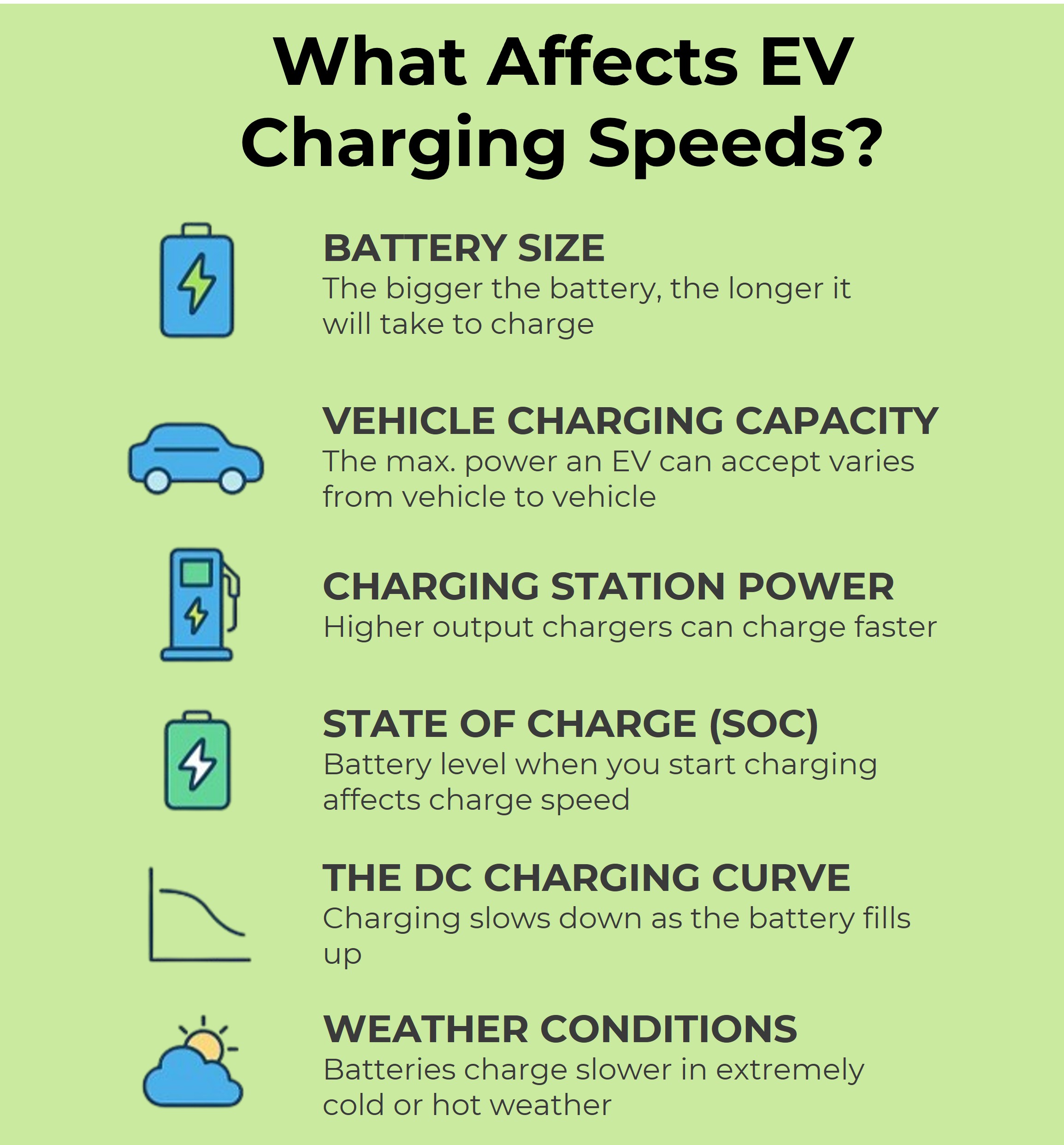
Several factors determine how quickly your electric car charges:
Battery Size
The larger the battery, the longer it takes to fill up. EV batteries are measured in kilowatt-hours (kWh) — similar to litres or gallons, but for electricity. One kWh is the energy needed to run a 1,000-watt appliance for an hour. Most EVs today have batteries between 25 and 100 kWh, with the average around 69 kWh.
Vehicle Charging Capacity
Each EV has a maximum charging power it can accept, measured in kilowatts (kW). This limit is shown separately for AC (slower, home/public chargers) and DC (fast chargers). For example:
- If two EVs both have a 60 kWh battery and plug into the same 150 kW fast charger…
- One may only accept 50 kW, while the other can take 150 kW.
- The second car will charge much faster, even though the station is the same.
Charging Station Power
Not all chargers deliver the same output. A 22 kW public charger will fill your car faster than a 7.4 kW home wallbox. For DC fast charging, outputs range from 50 kW to 350 kW. The speed you actually get depends on whether your car can handle that output.
State of Charge (SOC)
How full your battery is when you start charging also matters. Topping up from 20% to 60% is quicker than going from 80% to 100%. Similar to fueling a petrol tank, filling the last bit always takes longer.
The DC Charging Curve (The “80% Rule”)
- AC charging: Power delivery stays fairly constant from 0–100%.
- DC fast charging: Starts with very high power, then slows down as the battery fills.
- EV batteries accept the most power when nearly empty.
- As they approach 80% full, charging speed drops to protect battery health.
- That’s why many drivers unplug at 80% during road trips — it’s faster to continue driving and charge again later.
Weather Conditions
Batteries work best at moderate temperatures (20–25°C / 68–77°F). In very cold or hot weather, charging slows down because the battery needs to be heated or cooled first. Some EVs precondition their battery before arriving at a fast charger to maximize speed.
Cost of EV Charging
Assumptions:
- Home Charging: Based on an average electricity cost of €0.30 per kWh.
- Public/Workplace Charging: Average cost of €0.54 per kWh in cities like Eindhoven.
- Fast Charging: Average cost of €0.79 per kWh for DC fast chargers.
Note: These costs are for a full battery charge and may vary based on specific charging providers and locations.
Additional Insights
- Home Charging: Generally the most cost-effective option, especially during off-peak hours. Installation of a home charger may involve initial setup costs.
- Public/Workplace Charging: Offers convenience when away from home, though costs can be higher. Prices vary by municipality and provider.
- Fast Charging: Ideal for long trips or when quick charging is necessary. However, it’s the most expensive option and should be used sparingly to avoid higher costs.
For real-time pricing and to locate charging stations, consider using apps like PlugShare, ANWB Onderweg, or Fastned.
Factors affecting prices:
The cost of charging an EV isn’t fixed; it depends on several key factors. Here’s a detailed breakdown:
Electricity Source & Pricing
- Home electricity rates: Prices vary depending on your utility provider, plan, and time of day. Many households pay €0.20–€0.40 per kWh in the Netherlands.
- Time-of-use tariffs: Some providers charge less during off-peak hours (e.g., night) and more during peak hours. Charging overnight can save money.
- Renewable energy: Charging with solar or other green energy may be cheaper or incentivized by subsidies.
Type of Charging
- AC Level 1 (home plug): Slow and cheap but may increase electricity bills if used frequently.
- AC Level 2 (home/public charger): Faster and slightly more expensive per kWh due to infrastructure costs.
- DC Fast Charging (Level 3): High-speed charging at public stations is the most expensive due to advanced equipment and grid demand.
Location & Provider
- Urban vs rural: Public charging in cities can be more expensive due to higher operating costs and demand.
- Charging network: Different providers (Fastned, Allego, Eneco, Shell Recharge) have different pricing models—some charge per kWh, others per minute.
- Workplace chargers: Sometimes free, subsidized, or included in your company’s benefits.
Vehicle & Battery
- Battery size: Larger batteries cost more to fully charge. For example, an 80 kWh EV costs roughly twice as much to fully charge as a 40 kWh EV.
- Charging speed capability: Vehicles that accept higher charging rates may use fast chargers more efficiently but can incur higher costs at DC fast stations.
Network & Transaction Fees
- Subscription fees: Some public networks require a monthly fee or membership.
- Per-session fees: Some chargers have a flat “start fee” regardless of kWh consumed.
- Idle fees: Some networks charge if the EV remains connected after charging is complete.
Seasonal & Market Effects
- Electricity market fluctuations: Prices can spike during high demand or energy shortages.
- Taxes & levies: VAT and government energy taxes in the Netherlands affect final costs.
Key Takeaway:
The cheapest option is usually home Level 2 charging during off-peak hours, while fast public charging is the most expensive, especially during peak demand. Costs also fluctuate by provider, location, and the size of your battery.